Start with a free discovery call
If you are unsure how we can best help, a discovery call is the right first step.


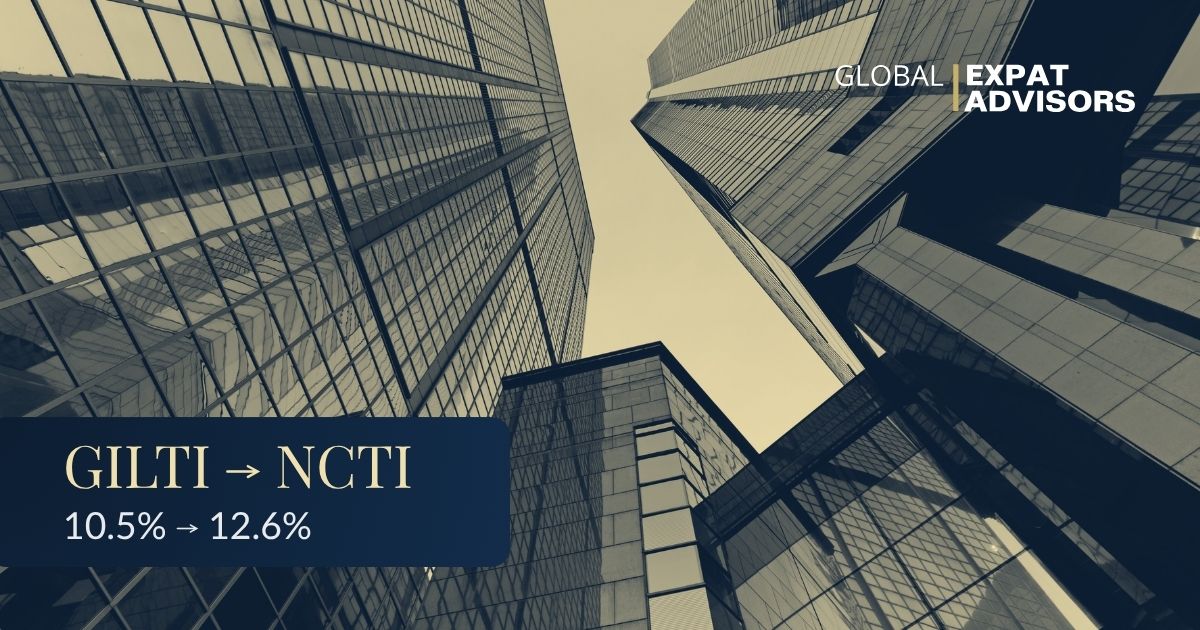

If you own a controlled foreign corporation as a US citizen, the term “GILTI” is no longer relevant. The “One Big Beautiful Bill Act” (OBBBA), signed into law on July 4, 2025 and effective January 1, 2026, removed it from IRC §951A entirely. It replaced GILTI with a new regime called Net CFC Tested Income (NCTI).
This is not a neutral rebranding. It changed the calculation and the deductions, eliminated a long-standing exclusion, and increased the effective tax rate. Founders who built their offshore structures around the old GILTI rules, should assess whether those structures still work as intended.
This post covers what changed with NCTI, who will be most affected, and planning options under the new rules. We also cover the Section 962 election, high-tax exclusion, and the FTC mechanics that determine whether you owe tax at all.
Net CFC Tested Income (NCTI) is the US tax regime that requires American shareholders of controlled foreign corporations (CFCs) to pay US tax on their share of the CFC’s profits each year. It doesn’t matter whether any money is actually distributed. It replaced GILTI (Global Intangible Low-Taxed Income) on January 1, 2026 under the One Big Beautiful Bill Act (OBBBA).
The core logic is unchanged from GILTI: if you own 10% or more of a foreign corporation that qualifies as a CFC, you cannot simply leave profits offshore and defer US tax indefinitely. NCTI pulls that income into your US return annually.
What changed under OBBBA is
The result is a broader base taxed at a slightly higher effective rate, with the foreign tax your CFC already paid offsetting more the US liability than it did before.
For most US founders with an offshore company, NCTI is not theoretical. If your CFC earns a profit and you haven’t structured around it, the inclusion happens automatically on your US return.
GILTI, short for Global Intangible Low-Taxed Income, was introduced by the Tax Cuts and Jobs Act of 2017 (TCJA). Its goal was to stop US multinationals from parking profitable intangible income in low-tax jurisdictions and deferring US tax indefinitely.
The way it worked: US shareholders who owned at least 10% of a controlled foreign corporation (CFC) were required to include their share of the CFC’s income in gross income each year, regardless of whether any profits were distributed. The intention was to create a minimum tax on offshore income.
Under TCJA, a key carveout softened the blow for businesses with significant physical operations abroad. You could exclude a net deemed tangible income return (NDTIR) equal to 10% of the CFC’s qualified business asset investment (QBAI), meaning tangible assets like factories, equipment, and real property. Only income above that threshold was swept into GILTI.
C corporations then applied a 50% Section 250 deduction, bringing the effective tax rate to 10.5% before foreign tax credits. Individual shareholders without a Section 962 election had no access to the Section 250 deduction and paid ordinary income rates of up to 37%.
That framework is now gone.
OBBBA replaced GILTI with Net CFC Tested Income (NCTI) for tax years beginning after December 31, 2025. The operative code section, IRC §951A, remains. The rules inside it changed substantially.
The 10% deemed return on tangible assets no longer exists. Every dollar of a CFC’s net tested income is now potentially subject to NCTI. There is no floor, no carveout for physical operations, no asset-based shield. A manufacturing company and a consulting company are treated identically for NCTI purposes.
Under TCJA, corporations (and individuals making a Section 962 election) could deduct 50% of their GILTI inclusion, producing a 10.5% effective rate. Under NCTI, that deduction is 40%. This raises the effective corporate rate to 12.6% (21% statutory rate multiplied by 60% of the inclusion).
Note: the TCJA had already scheduled a deduction reduction to 37.5% for 2026 and beyond. OBBBA set it permanently at 40%, which is slightly more favorable than the scheduled haircut would have been.
Previously, you could only use 80% of the foreign taxes attributable to your GILTI inclusion as a credit. Under NCTI, that figure rises to 90% (IRC §960(d)(1), effective for tax years beginning after December 31, 2025). More of the foreign tax you already paid counts toward your US liability.
With QBAI gone, more income flows through the NCTI calculation for the same CFC, even if the nominal tax rates remain the same. Capital-intensive businesses feel this most acutely.
The net effect is a somewhat higher rate (12.6% vs. 10.5%) applied to a significantly broader base (all net tested income vs. income above the tangible-asset return), partially offset by a more generous FTC cap.
Whether that nets out favorably depends entirely on the foreign tax rate your CFC actually pays.
Three categories of US founders should be doing this analysis now.
If your CFC is in the UAE, Cayman Islands, BVI, or another jurisdiction with no corporate income tax, you had no foreign tax credits to deploy under old GILTI. You still have none under NCTI.
The QBAI carveout was often the only meaningful offset for founders in these jurisdictions who held tangible assets in the structure. That carveout is gone. Your entire net tested income is now included with no QBAI buffer and no FTC to offset the US tax.
If your offshore structure holds significant physical assets, you may have been relying heavily on QBAI to keep your GILTI inclusion small. A hypothetical: a CFC with $1 million in net tested income and $5 million in tangible assets had a $500,000 QBAI exclusion under old GILTI, leaving only $500,000 subject to tax.
Under NCTI, the full $1 million is included. For businesses in that category, the effective NCTI exposure may be materially larger than the 2025 return suggested.
Individual US shareholders who don’t make a Section 962 election have no access to the Section 250 deduction and limited access to foreign tax credits at the CFC level. Their entire NCTI inclusion is taxed at ordinary income rates, potentially up to 37%. They have no structural relief unless the foreign jurisdiction itself paid enough tax to qualify for the high-tax exclusion.
If you’re an individual owner who hasn’t thought about the §962 election, NCTI raises the cost of that gap.
The cost of getting this wrong is almost always higher than the cost of getting it right the first time. Speak to a senior advisor who has handled this situation before.
Section 962 of the Internal Revenue Code allows an individual US shareholder to elect to be taxed on their NCTI inclusion (and Subpart F income) as if they were a US C corporation. The practical effect:
For an individual in a country where the CFC pays at least 14% in foreign corporate tax, the combination of the §962 election, the §250 deduction, and the 90% FTC cap can bring the US NCTI liability to near zero.
The math: 12.6% effective rate multiplied by 10% uncreditable portion of FTC equals a small residual at the margin. If the foreign tax rate comfortably exceeds 14%, it effectively eliminates the liability.
A few important limits apply:
First, you must make the election annually on your US individual tax return. It applies to all CFCs you hold as a US shareholder. You cannot elect §962 treatment for one CFC and ordinary treatment for another.
Second, a second-level tax applies when you later take actual distributions from the CFC. Previously-taxed earnings and profits distributed to you are taxed again, this time as ordinary dividend income without the benefit of the §962 election. This means the election defers but does not necessarily eliminate the US tax on actual cash repatriations.
Third, the election requires filing Form 1118 to compute the deemed paid foreign tax credit alongside your individual return.
The §962 election has become more valuable under NCTI than it was under GILTI. This is mostly because the 90% FTC cap (up from 80%) lowers the breakeven foreign tax rate.
But whether it’s the right choice for a given situation depends on the full picture:
There are two separate thresholds that come up in NCTI planning. Conflating them is a common source of confusion.
If your CFC pays at least 14% in effective foreign corporate tax, and you make a Section 962 election, the foreign tax credits available under the 90% cap are generally sufficient to fully offset your US NCTI liability. This is not an exclusion from the NCTI base. The income is still included; the tax is simply offset dollar for dollar by foreign taxes paid.
This is a different and more complete form of relief. Under the HTE, if a CFC’s income in a given jurisdiction is taxed at an effective foreign rate exceeding 90% of the US corporate rate (90% multiplied by 21% equals 18.9%), the shareholder may elect to exclude that income from the NCTI base entirely. It is never included in the first place.
The HTE election is made annually on Form 8992 and applies on a country-by-country basis. Importantly, it is all-or-nothing within a jurisdiction. You cannot cherry-pick which income streams within a country to exclude. Income excluded under the HTE cannot generate foreign tax credits, so electing the HTE forecloses the FTC option for that income.
In practice:
The HTE threshold itself didn’t change from GILTI; it remains 18.9% under NCTI. What changed under OBBBA is the FTC mechanics, which lowered the FTC breakeven from approximately 13.1% to approximately 14%. (The small increase in breakeven reflects the higher 12.6% effective rate on a broader base, partially offset by the improved 90% FTC cap.)
NCTI has been in effect since January 1, 2026. If you have a CFC and haven’t done a fresh analysis under the new rules, here is where to focus before the year closes.
The QBAI elimination means your 2026 inclusion will almost certainly be larger than your 2025 GILTI inclusion, even if the CFC’s income and the foreign tax rate remain the same. The first step is knowing the number.
You make the election on the return, but the planning analysis should happen before year-end because it affects how you think about distributions. If you’re likely to take distributions from the CFC in 2026, the §962 election’s second-level tax on distributions is a factor in the timing decision.
One structural option for single-owner CFCs is a check-the-box election to treat the foreign entity as a disregarded entity for US tax purposes. This avoids the NCTI regime entirely, because a disregarded entity is not a CFC. The tradeoff: income flows directly onto your individual return and may be subject to self-employment tax (15.3%) unless a totalization agreement applies.
For lower-income structures, the math can favor disregarded status. For higher-income structures, the SE tax exposure typically outweighs the NCTI liability. This is a calculation, not a default.
Holding companies designed to accumulate tangible assets for the express purpose of inflating QBAI now carry that cost with no corresponding tax benefit. The structure may need simplification.
The transition from GILTI to NCTI should trigger a broader review of whether your offshore structure is still doing what it was designed to do.
Structures built under TCJA often had specific features justified by the GILTI mechanics. Those included QBAI optimization, US parent holding companies to access §250, specific entity counts to aggregate tested income and tested losses across CFCs. Some of those features remain valuable under NCTI; others are now carrying administrative cost without a corresponding tax benefit.
What a proper NCTI review looks like in an integrated advisory context:
All considered together rather than one at a time.
A review that only addresses the NCTI calculation without looking at the distribution strategy, for example, may miss the §962 second-level tax exposure. But that affects whether taking a dividend in 2026 is the right move.
Our offshore business structuring service covers the full picture: entity structure, tax elections, NCTI planning, and ownership design, treated as a single strategy rather than separate decisions.
Net CFC Tested Income (NCTI) is the name for the controlled foreign corporation income inclusion regime. OBBBA replaced the former GILTI (Global Intangible Low-Taxed Income) regime with NCTI, effective January 1, 2026.
The core concept is the same: US shareholders who own 10% or more of a CFC must include their share of the CFC’s net tested income in gross income each year, whether or not any profits are distributed. The key differences are that NCTI eliminates the QBAI exclusion, reduces the Section 250 deduction from 50% to 40%, and increases the foreign tax credit cap from 80% to 90%.
For a C corporation or an individual making a Section 962 election, the effective US tax rate on NCTI is 12.6% before foreign tax credits. This reflects the 21% statutory corporate rate applied to 60% of the NCTI inclusion (after the 40% Section 250 deduction).
Foreign tax credits can reduce or eliminate this liability depending on the foreign tax rate the CFC actually paid. For an individual without a Section 962 election, NCTI is taxed at ordinary income rates of up to 37%, with no Section 250 deduction available.
No. OBBBA eliminated the qualified business asset investment (QBAI) exclusion, which allowed shareholders to reduce their GILTI inclusion by 10% of the CFC’s tangible asset base, effective January 1, 2026. For the 2025 tax year (returns filed in 2026), the old GILTI rules including QBAI still applied. Beginning with the 2026 tax year, the full net tested income of a CFC is potentially subject to NCTI with no tangible-asset carveout.
The high-tax exclusion (HTE) threshold, which allows a shareholder to exclude income from the NCTI base entirely, remains at 18.9% (90% of the 21% US corporate rate). If a CFC’s income in a given jurisdiction is subject to an effective foreign tax rate above 18.9%, the shareholder may annually elect to exclude that income from NCTI on Form 8992.
Whether the election makes sense depends on the CFC’s foreign tax rate, the distribution strategy, and the full ownership structure.
For individuals whose CFC pays at least 14% in foreign corporate tax, the election can eliminate most or all of the US NCTI liability. The tradeoffs: the election applies to all CFCs held (no cherry-picking); you must make it annually, and a second-level tax applies to actual distributions of previously-taxed income.
NCTI applies to all US shareholders who own 10% or more of a controlled foreign corporation, including individuals, C corporations, S corporations (with modifications), and trusts. The tax treatment differs by entity type. C corporations access the 40% Section 250 deduction and 90% FTC directly.
Individuals do not have access to those benefits unless they make a Section 962 election. Without the election, individuals include their full NCTI in gross income and pay tax at ordinary income rates (up to 37%) with limited FTC access. S corporations and partnerships pass the NCTI inclusion through to their owners, who then face the same individual vs. §962 election analysis.
NCTI is not a paperwork change. For founders in low-tax jurisdictions who relied on the QBAI carveout, for individual owners who haven’t addressed the §962 election, and for structures built around TCJA mechanics that no longer apply, the rules have materially shifted.
The planning window for 2026 is still open, but the relevant decisions (entity classification, §962 elections, distribution timing, structural review) need to happen before year-end to have effect for this tax year.
NCTI changes the math for almost every US founder with an offshore company. The right response depends on your jurisdiction, your foreign tax rate, your ownership structure, and your distribution strategy, considered together. At GEA, we review these as an integrated picture, not separate questions. Speak to a senior advisor to understand where you stand and what, if anything, needs to change before year-end.
This article is for general educational purposes and reflects guidance current as of July 2026. Tax law and thresholds change frequently. The right approach for your situation depends on facts specific to you. To discuss your circumstances with an advisor, speak to a senior advisor on the GEA team.
If you are unsure how we can best help, a discovery call is the right first step.